
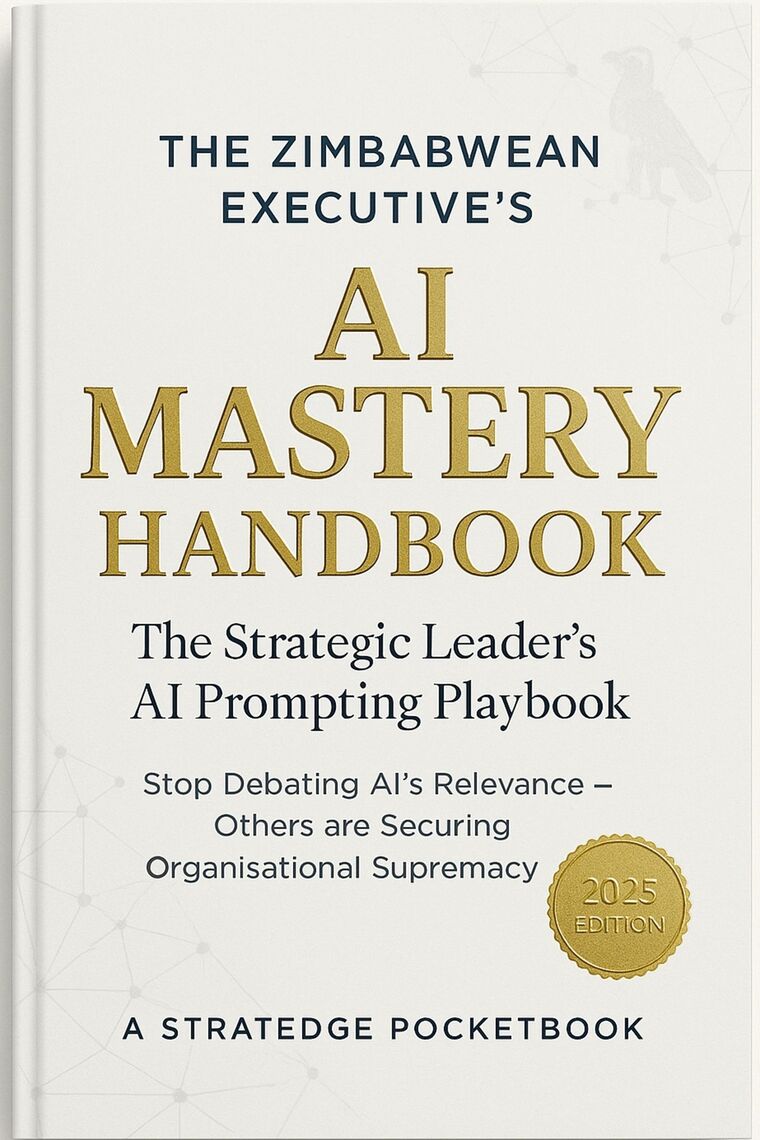
READ THESE DISCLAIMERS CAREFULLY BEFORE PROCEEDING. By reading, implementing, or distributing any content from this handbook, you acknowledge full understanding and acceptance of these terms and conditions.
EXECUTIVE DECISION-MAKING AND FIDUCIARY RESPONSIBILITY DISCLAIMER
Ultimate Leadership Accountability: This handbook provides strategic guidance on leveraging artificial intelligence for executive decision-making. However, you retain complete and absolute responsibility for all business decisions, strategic choices, and organisational outcomes resulting from your leadership.
Critical Leadership Warning:
- You remain fully accountable to shareholders, boards of directors, stakeholders, and regulatory authorities
- AI assistance does not diminish your fiduciary duties or legal obligations as an executive
- All strategic decisions must comply with corporate governance requirements and Zimbabwean company law
- Never delegate final decision-making authority to AI systems
- Maintain independent verification of all AI-generated analysis before implementation
- Your professional judgement and experience cannot be replaced by artificial intelligence
Corporate Governance Compliance: Ensure all AI-assisted decisions comply with:
- Companies and Other Business Entities Act (Chapter 24:31)
- Securities and Exchange Commission of Zimbabwe (SECZ) regulations
- Zimbabwe Stock Exchange (ZSE) listing requirements where applicable
- Industry-specific regulatory frameworks
- International corporate governance standards adopted by your organisation
BUSINESS PERFORMANCE AND FINANCIAL PROJECTIONS DISCLAIMER
No Performance Guarantees: This handbook makes absolutely no guarantees regarding:
Organisational Outcomes:
- Revenue growth, profit increases, or cost reductions
- Market share expansion or competitive advantage
- Operational efficiency improvements
- Employee productivity gains
- Customer satisfaction or retention improvements
- Return on investment from AI implementation
Financial Projections Warning: Any references to economic growth, GDP projections, or market opportunities are:
- Based on third-party economic forecasts that may prove incorrect
- Subject to volatile economic conditions beyond organisational control
- Not guarantees of future business performance
- Estimates that should not form the basis of investment decisions without independent economic analysis
Zimbabwe Economic Context: Zimbabwe's economic environment presents exceptional volatility including:
- Multi-currency system instability and potential policy changes
- Foreign exchange allocation constraints and regulatory changes
- Inflation volatility affecting operational costs
- Infrastructure challenges impacting business continuity
- Political and policy uncertainty affecting long-term planning
ARTIFICIAL INTELLIGENCE TECHNOLOGY LIMITATIONS
Fundamental AI Limitations: All AI systems referenced in this handbook have significant constraints:
Technical Limitations:
- AI responses are based on training data with inherent biases and gaps
- AI cannot account for real-time market conditions or organisational nuances
- AI analysis may contain factual errors, logical flaws, or inappropriate recommendations
- AI systems cannot understand complex organisational politics or cultural dynamics
- AI outputs require human interpretation and contextualisation
Strategic Decision-Making Limitations:
- AI cannot replace human intuition, ethical reasoning, or stakeholder relationship management
- AI analysis may miss critical qualitative factors affecting business decisions
- AI recommendations may not align with organisational values or long-term strategic objectives
- AI systems cannot assess reputational risks or stakeholder sentiment accurately
Data Security and Confidentiality Risks:
- AI platforms may store, analyse, or inadvertently expose confidential business information
- Proprietary strategic information should never be input into external AI systems
- Compliance with data protection regulations remains your responsibility
- Third-party AI providers may have access to your organisational data
PROFESSIONAL AND REGULATORY COMPLIANCE DISCLAIMER
Regulatory Adherence: AI assistance does not ensure compliance with:
Zimbabwean Regulatory Framework:
- Reserve Bank of Zimbabwe (RBZ) foreign exchange regulations
- Zimbabwe Revenue Authority (ZIMRA) tax compliance requirements
- Competition and Tariff Commission regulations
- Environmental Management Authority (EMA) requirements
- Medicines Control Authority of Zimbabwe (MCAZ) for relevant sectors
- Insurance and Pensions Commission (IPEC) requirements
Industry-Specific Compliance: Executives in regulated industries must ensure:
- Banking: Compliance with Banking Act and prudential requirements
- Mining: Adherence to Mines and Minerals Act and environmental regulations
- Manufacturing: Compliance with Standards Association of Zimbabwe requirements
- Import/Export: Adherence to international trade regulations and sanctions compliance
Professional Standards: Maintain compliance with professional body requirements:
- Institute of Directors Zimbabwe (IoD Zimbabwe)
- Confederation of Zimbabwe Industries (CZI) ethical standards
- Relevant professional accounting, legal, or technical body requirements
LIABILITY LIMITATIONS AND RISK ALLOCATION
Comprehensive Liability Exclusion: To the maximum extent permitted by Zimbabwean law, the authors, publishers, distributors, and associated parties:
Disclaim All Liability For:
- Direct, indirect, incidental, consequential, or punitive damages
- Business losses, lost profits, or opportunity costs
- Reputational damage or stakeholder relationship harm
- Regulatory fines, penalties, or compliance failures
- Employment-related disputes or wrongful termination claims
- Data breaches or cybersecurity incidents
- Strategic failures or competitive disadvantages
Business Risk Acknowledgement: Executive leadership inherently involves significant risks including:
- Market volatility and competitive pressures
- Operational failures and supply chain disruptions
- Human resource challenges and talent retention
- Technology failures and cybersecurity threats
- Regulatory changes and compliance costs
- Force majeure events affecting business continuity
INTELLECTUAL PROPERTY AND USAGE RESTRICTIONS
Copyright Protection: This handbook is protected by comprehensive intellectual property rights:
- All content, methodologies, and frameworks are proprietary
- Reproduction, distribution, or commercial use requires explicit written authorisation
- Corporate training or internal distribution must comply with licensing terms
- Translation or adaptation rights are specifically reserved
AI Platform Intellectual Property: Usage of mentioned AI platforms is subject to their respective terms:
- OpenAI (ChatGPT): Subject to OpenAI's commercial terms and usage policies
- Google (Gemini): Governed by Google Cloud terms and AI principles
- Microsoft (Copilot): Subject to Microsoft's enterprise agreements and AI ethics guidelines
- Any proprietary AI systems: Subject to their specific licensing and usage terms
Competitive Intelligence Warning: Information derived from AI analysis of competitive data must respect:
- Trade secret and proprietary information boundaries
- Anti-competitive behaviour regulations
- Ethical business intelligence practices
- Industry confidentiality agreements
DATA PRIVACY AND CYBERSECURITY WARNINGS
Critical Data Protection Requirements:
Confidential Information Prohibition:
- Never input customer personal data, financial records, or proprietary business information into external AI systems
- Avoid sharing strategic plans, merger discussions, or sensitive commercial information
- Protect employee personal information and HR-related data
- Maintain confidentiality of board discussions and executive decisions
Cybersecurity Considerations:
- AI platform interactions may be monitored, stored, or analysed by providers
- Implement appropriate cybersecurity measures for AI-related business processes
- Regular security audits of AI tool usage within your organisation
- Employee training on secure AI usage practices
Regulatory Compliance:
- Data Protection Act compliance where applicable
- International data transfer regulations
- Industry-specific data handling requirements
- Customer and stakeholder privacy expectations
EMPLOYMENT AND HUMAN RESOURCES IMPLICATIONS
Employment Law Compliance: AI-assisted HR decisions must comply with:
Zimbabwean Labour Law:
- Labour Act (Chapter 28:01) requirements
- National Employment Council agreements
- Workers' compensation and occupational health regulations
- Anti-discrimination and equal opportunity legislation
Ethical AI in HR:
- Avoid AI bias in recruitment, promotion, and performance evaluation
- Maintain human oversight of all employment-related decisions
- Transparent AI usage policies for employee-related processes
- Regular auditing of AI systems for discriminatory outcomes
Change Management: AI implementation may require:
- Consultation with employee representatives or unions
- Retraining and skills development programmes
- Transparent communication about AI's role in organisational processes
- Consideration of employment impact and workforce planning
SECTOR-SPECIFIC WARNINGS
Financial Services:
- Comply with banking regulations and prudential requirements
- Maintain audit trails for AI-assisted financial decisions
- Ensure AI recommendations align with risk management frameworks
- Regular stress testing of AI-influenced financial models
Mining and Natural Resources:
- Environmental impact assessments remain mandatory
- Safety protocols cannot be automated without human oversight
- Community consultation requirements are not affected by AI efficiency
- Export compliance and international sanctions must be independently verified
Manufacturing and Agriculture:
- Quality control standards require human verification
- Supply chain AI analysis must account for local supplier reliability
- Export certification and standards compliance remain your responsibility
- Seasonal and climatic factors require local expertise validation
Technology and Telecommunications:
- Data localisation requirements must be independently verified
- Cybersecurity standards exceed AI recommendations
- Intellectual property protection requires legal expert involvement
- International technology transfer regulations apply regardless of AI advice
ECONOMIC AND MARKET CONDITIONS DISCLAIMER
Economic Volatility: Zimbabwe's economic environment presents exceptional challenges:
Currency and Financial Risks:
- Multi-currency system instability affecting pricing and planning
- Foreign exchange allocation uncertainties
- Banking sector liquidity constraints
- Inflation impact on operational costs and strategic planning
Infrastructure Challenges:
- Power supply interruptions affecting AI system reliability
- Internet connectivity limitations impacting AI tool effectiveness
- Transportation infrastructure constraints affecting supply chain AI recommendations
- Telecommunications reliability issues affecting real-time AI analysis
Political and Regulatory Environment:
- Policy changes may invalidate AI-based strategic recommendations
- Regulatory framework evolution affecting compliance requirements
- International sanctions considerations requiring independent legal advice
- Political stability factors affecting long-term strategic planning
COMPETITIVE INTELLIGENCE AND MARKET ANALYSIS LIMITATIONS
Market Analysis Accuracy: AI-generated market analysis may be limited by:
- Lack of real-time local market data
- Insufficient understanding of Zimbabwean consumer behaviour
- Limited access to competitor private information
- Cultural and social factors affecting market dynamics
Competitive Strategy Warning:
- AI recommendations must be verified against actual market conditions
- Competitor analysis may be based on outdated or incomplete information
- Local market expertise remains essential for strategic decision-making
- Regulatory constraints may limit AI-suggested competitive strategies
TECHNOLOGY DEPENDENCY AND SYSTEM RELIABILITY
Technology Risk Management:
- AI systems may experience downtime, errors, or performance degradation
- Internet connectivity issues may affect AI tool accessibility
- Regular backup systems and manual processes must be maintained
- Technology vendor reliability and support quality varies significantly
Business Continuity Planning:
- AI-dependent processes require manual backup procedures
- Staff training on non-AI alternatives remains essential
- Regular testing of business continuity plans including AI system failures
- Vendor risk assessment for critical AI service providers
STAKEHOLDER RELATIONSHIP AND COMMUNICATION DISCLAIMER
Stakeholder Communication: AI-assisted communication must maintain:
- Cultural sensitivity appropriate to Zimbabwean business context
- Professional standards expected by international partners
- Regulatory compliance in all external communications
- Accuracy and accountability in stakeholder reporting
Board and Investor Relations:
- AI analysis does not replace independent due diligence
- Financial projections require professional accounting verification
- Investment decisions must include human judgement and risk assessment
- Regulatory reporting cannot rely solely on AI-generated content
CONTINUOUS LEARNING AND ADAPTATION REQUIREMENTS
Professional Development: Executive AI mastery requires:
- Continuous learning about AI technology evolution
- Regular updating of AI usage policies and procedures
- Ongoing assessment of AI impact on organisational culture
- Professional development in AI ethics and responsible usage
Industry Evolution: The AI landscape changes rapidly:
- Current AI capabilities may become obsolete quickly
- New regulatory requirements may affect AI usage
- Competitive advantages from AI may be temporary
- Continuous innovation and adaptation are essential
FORCE MAJEURE AND UNFORESEEABLE CIRCUMSTANCES
Uncontrollable Events: This handbook cannot account for:
- Natural disasters affecting business operations
- Political instability or policy changes
- Global economic crises or market disruptions
- Technology failures or cybersecurity attacks
- Pandemic or health emergency impacts
- International sanctions or trade restrictions
GOVERNING LAW AND DISPUTE RESOLUTION
Legal Framework:
- These disclaimers are governed by Zimbabwean law
- Disputes subject to Zimbabwe High Court jurisdiction
- International arbitration options available for cross-border disputes
- Professional mediation preferred for business-related disputes
Regulatory Reporting: Any legal disputes involving AI-assisted decisions may require:
- Disclosure to relevant regulatory authorities
- Audit trail documentation of AI usage in decision-making
- Professional liability insurance coverage assessment
- Legal representation with AI expertise
ACKNOWLEDGEMENT OF EXECUTIVE RESPONSIBILITY
By proceeding with this handbook, you acknowledge that:
- Ultimate Accountability: You accept complete responsibility for all business decisions and outcomes
- Due Diligence: You will independently verify all AI-generated analysis and recommendations
- Regulatory Compliance: You will ensure all activities comply with applicable laws and regulations
- Risk Management: You understand and accept all risks associated with AI-assisted executive decision-making
- Professional Standards: You will maintain the highest standards of corporate governance and business ethics
- Stakeholder Protection: You will prioritise stakeholder interests and fiduciary responsibilities
- Continuous Monitoring: You will regularly assess and adapt AI usage based on results and changing circumstances
Final Executive Warning: This handbook is designed to enhance your existing executive capabilities, not replace fundamental business acumen, industry expertise, or ethical leadership. AI is a powerful tool, but executive success ultimately depends on your judgement, experience, and ability to lead people through complex challenges.
Emergency Business Continuity Contacts:
- Legal Counsel: Maintain relationships with qualified business lawyers
- Financial Advisors: Independent certified public accountants and financial analysts
- Industry Experts: Relevant technical and sector specialists
- Regulatory Contacts: Appropriate government and industry regulatory bodies
- Crisis Management: Public relations and crisis communication specialists
These disclaimers constitute an integral part of this handbook and supersede any conflicting statements within the main content. The authors reserve the right to update these disclaimers in subsequent editions. Your continued use of this handbook constitutes acceptance of any such updates.